Tamotzu and the Hiroshima–Santa Fe Exchange: Art as Postwar Reconciliation
In 1953, Japanese American artist Chuzo Tamotzu organized an art exchange between schoolchildren in Hiroshima, Japan and Santa Fe, New Mexico. This event took place less than a decade after World War II, during a time of global tension and rebuilding. Tamotzu, who had lived in Japan and the United States and later settled in Santa Fe, used art as a way to connect communities affected by war. This project is significant because it shows how AAPI individuals in New Mexico were not isolated, but actively shaping global conversations about peace and identity. I argue that Tamotzu’s work demonstrates how AANHPI communities in New Mexico played an important role in postwar reconciliation, using cultural exchange to challenge division and create new forms of belonging.
Why This Event Was Newsworthy
The 1953 art exchange between Hiroshima and Santa Fe was newsworthy because it represented a rare moment of cultural connection between former enemies shortly after World War II. A Time magazine article, “Through the Eyes of Children,” highlighted how children’s drawings could communicate hope and resilience despite the devastation of the atomic bomb. The use of children’s artwork made the story especially powerful, as it emphasized innocence and the possibility of rebuilding relationships through creativity rather than politics.
At a time when anti-Japanese sentiment was still strong in the United States, Tamotzu’s project challenged dominant narratives by promoting empathy and understanding. Newspaper sources and later exhibitions show that this exchange gained attention not only for its artistic value, but for its message of peace. By framing the exchange as a collaborative effort between children, the media presented it as a hopeful alternative to the conflict that had defined the previous decade. This made the event both emotionally compelling and politically meaningful. 1
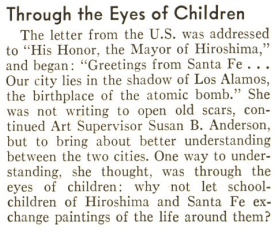
![The TIME Magazine promotes the art exchange between kids in Santa Fe and Hiroshima. [Source: TIME Magazine, May 11, 1953]()](/History-1105/essays/chuzo-tamotzu/images/newspaper-2.png)
The TIME Magazine promotes the art exchange between kids in Santa Fe and Hiroshima. Source: TIME Magazine, May 11, 1953
This TIME Magazine quote provides the goal of what this art exchange aimed to achieve, a connection between two cities, and furthermore, between two cultures.2
Connection to AAPI History
This event is important to AAPI history because it reflects how Japanese Americans navigated identity and belonging after World War II. During the war, Japanese Americans faced discrimination, incarceration, and pressure to prove their loyalty, as seen in sources like the “Declaration by Japanese-American Artists” (1941). Tamotzu’s later work shows a shift from survival to rebuilding identity and community.
By organizing the art exchange, Tamotzu used his position as both a Japanese-born and American-based artist to bridge cultural divides. This reflects a broader pattern in AAPI history, where individuals created transnational connections despite exclusion and racism. His work demonstrates how AAPI communities contributed not only to local culture, but also to global efforts toward reconciliation and peace.
![untitled (schoolchild's drawing from Hiroshima, Japan), 1953, crayon, pencil, watercolor, tempera, by Suzuko Tamagawan [Source: Bowdoin College Museum of Art] (1953)](/History-1105/essays/chuzo-tamotzu/images/drawing-2.jpg)
untitled (schoolchild’s drawing from Hiroshima, Japan), 1953, crayon, pencil, watercolor, tempera, by Suzuko Tamagawan [Source: Bowdoin College Museum of Art] (1953)
Bowdoin College Museum of Art hosts an online exhibit containing a selection of works by Japanese children and by Chuzo Tamotzu that showcase an art exchange between elementary school students in Santa Fe and Hiroshima in the early 1950s. His intention behind these pieces was said to be seeking “reconciliation between the country of his birth and that of his home… young people, raised in the wake of the devastating explosion of the atomic bomb, could heal political rifts by offering a fresh perspective on the world and thus help to establish lasting peace.” (Bowdoin College Museum of Arts, 2017)
Connection to New Mexico History
This event also highlights New Mexico’s role as a unique cultural and artistic space that attracted diverse communities, including AAPI individuals. After moving to Santa Fe in 1948, Tamotzu became part of the city’s growing art scene, which was known for its openness to different cultural influences. Local newspaper sources show that he was recognized as an important figure in the community and contributed to its artistic identity.
The art exchange reveals that New Mexico was not isolated, but connected to global events and cultural movements. Santa Fe served as a site where international dialogue could take place, even in the aftermath of war. This challenges the idea of New Mexico as peripheral and instead positions it as a place where cross-cultural exchange and innovation occurred.
![Chuzo Tamotzu (1888-1975) an important figure in the local Santa Fe art community and later organized the 1953 Hiroshima–Santa Fe art exchange. [Source: Bowdoin College Museum of Art] (January 10, 2017 - April 16, 2017)](/History-1105/essays/chuzo-tamotzu/images/tamotzu.jpg)
Chuzo Tamotzu (1888-1975) an important figure in the local Santa Fe art community and later organized the 1953 Hiroshima–Santa Fe art exchange. [Source: Bowdoin College Museum of Art] (January 10, 2017 - April 16, 2017)
This quote illustrates how Tamotzu’s work fostered emotional and cultural healing, framing the art exchange as a meaningful step toward reconciliation between Japan and the United States.3
Conclusion
The Hiroshima-Santa Fe art exchange is historically significant because it shows how art can serve as a tool for healing, connection, and identity formation. Chuzo Tamotzu’s work demonstrates that AAPI individuals in New Mexico were active participants in shaping both local and global histories. This event teaches us that reconciliation is not only achieved through political agreements, but also through cultural and human connections.
This project also raises further questions about how other AAPI communities in New Mexico contributed to the state’s history and how their stories have been remembered or overlooked. Future research could explore similar examples of cross-cultural exchange or examine how AAPI artists continue to shape New Mexico’s cultural landscape today.
-
TIME Magazine, Through the Eyes of Children (TIME Inc.:1953), 78. ↩
-
TIME Magazine, Through the Eyes of Children (TIME Inc.:1953), 78. ↩
-
Bowdoin College Museum of Art, Perspectives from Postwar Hiroshima Chuzo Tamotzu, Children’s Drawings, and the Art of Resolution (Buwdoin College Museum of Art: 2017). ↩